News
How LFP became the volume chemistry, and what Europe still needs to build

For much of the past decade, lithium iron phosphate was treated as a practical chemistry with a ceiling. It was safe, durable, and affordable, making it useful for buses, taxis, and stationary storage, but the industry often saw it as too heavy and with too limited energy density for mainstream passenger vehicles.
That assumption no longer holds.
In 2025, LFP overtook nickel-based chemistries to become the dominant lithium-ion battery chemistry.
Benchmark Mineral Intelligence put LFP’s global share at around 61% for the year, after LFP had accounted for roughly 20% of the market in 2020. In China, LFP accounted for 81.2% of total EV battery installations in 2025, with an installed capacity of 625.3 GWh and a year-on-year growth of 52.9%.
The chemistry that was once treated as a lower-cost alternative now sets the direction for the highest-volume parts of the battery market.
The chemistry started in Western labs
LFP was first developed in the 1990s at the University of Texas at Austin, where Akshaya Padhi worked under John Goodenough on lithium iron phosphate as a cathode material.
The appeal was clear from the start. Iron and phosphate are widely available, the crystal structure is stable at high temperatures, and the chemistry avoids nickel and cobalt.
The problem was conductivity.
Pure LFP behaves almost like an insulator, meaning early cells could be stable and long-lasting yet struggle to deliver the power required for commercial applications. Hydro-Québec and Université de Montréal later helped solve that problem by coating LFP particles with a thin carbon layer, giving electrons a conductive path through the material.
After that, the work became less about the discovery itself and more about manufacturing. Particle size, coating consistency, process control, and yield determined whether the chemistry could move from promising lab results to an industrial product.
Western companies were early to that process.
A123 Systems, founded out of MIT in 2001, built high-power LFP cells for power tools and the Fisker Karma plug-in hybrid, and received $249 million in U.S. Department of Energy grants to support domestic cell production. The company filed for Chapter 11 in October 2012, and Wanxiang Group (a Chinese company) acquired its assets in early 2013 for around $257 million.
Science had moved early in the West, but industrial-scale development moved elsewhere.
Why the old view broke down
For years, the case against LFP was built around cell-level energy density.
Typical LFP cells sat around 90 to 120 Wh/kg, while NMC cells were commonly in the 200 to 250 Wh/kg range. For passenger vehicles, where range was the headline metric, nickel-based chemistries looked like the natural choice.
That view weakened as exposure to raw material became harder to ignore. Nickel and cobalt added cost volatility, and both materials carried supply-chain risks that became more visible as EV production scaled. LFP removed cobalt from the cathode and replaced nickel with iron and phosphorus, giving manufacturers a lower-cost chemistry with reduced exposure to concentrated raw material supply.
The second shift came through the pack design.
BYD had been using LFP cells since the E6 taxi program in 2009, but its Blade Battery, introduced in March 2020, changed the industry’s view of LFP packaging. CATL’s cell-to-pack designs pushed in the same direction by reducing inactive material and using pack volume more efficiently.
At that point, the comparison moved from cell-level energy density to system-level performance: usable energy, pack cost, cycle life, and safety under daily use.
On that basis, LFP became much harder to dismiss.
Tesla’s move to LFP for standard-range Model 3 production in 2021 gave the chemistry further validation.
Once one of the world’s highest-volume EV makers adopted LFP for mainstream vehicles, the chemistry was no longer confined to buses, storage, and low-cost city cars.
The technical gap narrowed
Nickel-based chemistries still matter in premium long-range vehicles and high-performance applications, but their advantage in the mass market has narrowed. LFP has improved at the cell level, while pack design has reduced the practical penalty that once limited its use.
The clearest example is CATL’s third-generation Shenxing battery, released in April 2026, which charges from 10% to 98% state of charge in 6 minutes and 27 seconds at peak rates of 15C. That single figure changes the old assumption that LFP must trade lower cost for slower charging.
Energy density has also moved. High-compaction LFP cells now exceed 200 Wh/kg, and BYD’s Blade 2.0 sits in the same performance band. That does not make NMC obsolete, but it changes where NMC is needed. For mass-market EVs, commercial fleets, and stationary storage, LFP now covers the performance requirements that matter most.
Europe’s issue is the supply chain
Europe wants LFP for the same reasons as the rest of the market.
The chemistry lowers pack cost, improves cycle life, and reduces dependence on nickel and cobalt. It suits mass-market EVs, commercial vehicles, buses, grid storage, and industrial backup systems, where the total cost of ownership matters more than maximum range.
The problem is supply.
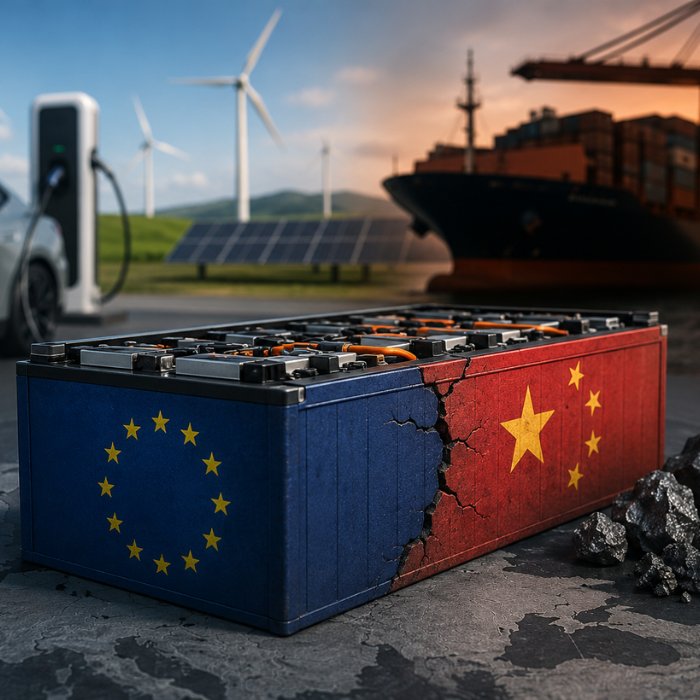
In 2024, 99% of LFP cells and 99% of LFP cathode active material were produced in China. Even when final cell assembly happens outside China, the upstream layers still determine cost, lead times, and industrial value.
That distinction matters for Europe.
Cell capacity without a local cathode supply is not the same as a localized battery value chain. OEMs may be able to source cells assembled closer to home, but the cost base and supply risk still sit upstream if cathode material comes from outside the region.
For Europe, the question is whether LFP manufacturing stops at cell assembly or moves deeper into the value chain. Cathode active material, precursors, and recycling will decide how much of the value stays in Europe.
What execution looks like in Europe
Europe already has one concrete LFP blade-cell production base, but the larger test is whether that early capacity can become a competitive industrial operation. That means output, yield, quality, and upstream supply have to improve together.
We have been working on these issues from Subotica, where our Serbian pilot line produces LFP blade cells designed for cell-to-pack and cell-to-body integration. The EDGE574 cell reaches 190 Wh/kg and 420 Wh/L and powers a 210-cell pack rated at 1 MW of peak charging power. The EDGE500 uses the same blade geometry for stationary storage and commercial vehicle applications.
The next step is our 1GWh LFP Megafactory, which has been under construction since February 2026.
The project moves the company beyond pilot-scale production and toward industrial manufacturing, with the goal of supplying European customers from a European LFP production base.
The issue is local supply. Demand already exists across EVs, fleets, and storage, but the value will stay in Europe only if production moves beyond final assembly.
LFP is already the volume chemistry. Europe’s task now is to build enough of the value chain to keep more of that volume, cost, and margin at home.